Published February 12, 2024 by GWW Staff
A curated collection of tips from leading experts on gov tech, continuous improvement, and accessibility for the public sector, featuring Jennifer Pahlka, Cyd Harrell, Kevin Ferguson, and more.
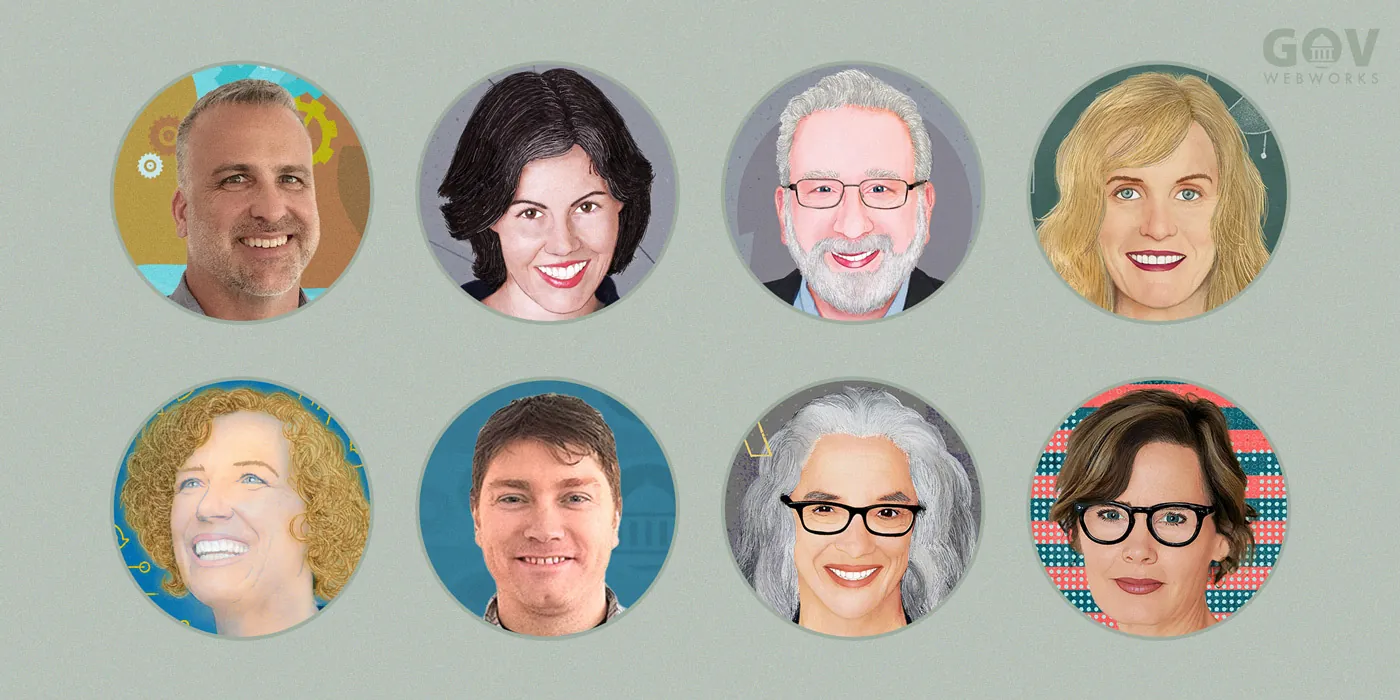
Our public sector Insider Insights tips bring together perspectives from authors, consultants, coaches, our team members, and other leading experts on topics relating to online digital innovation and agile practices for for gov tech.
We invite you to save the Insider Insights tips below. Click the “Get Tips” link or click on the tips graphic and right click to save the image. If you are using assistive technology, we recommend the text tips for best accessibility.
Gov Tech
- Jennifer Pahlka on changing the culture of gov tech
- Cyd Harrell on adopting a user-centered mindset
- Tara McGuinness and Hana Schank on improving digital government services
Continuous Improvement
- Kevin Ferguson on turning ideas into outcomes with goal setting
- Kristen Cox on making government agencies more effective with Theory of Constraints
- Bob Galen on leading by example with agile coaching skills
Accessibility
- Lainey Feingold on building a culture of accessibility
- David Read on fixing online accessibility errors
Gov Tech
Jennifer Pahlka: Changing the culture of gov tech
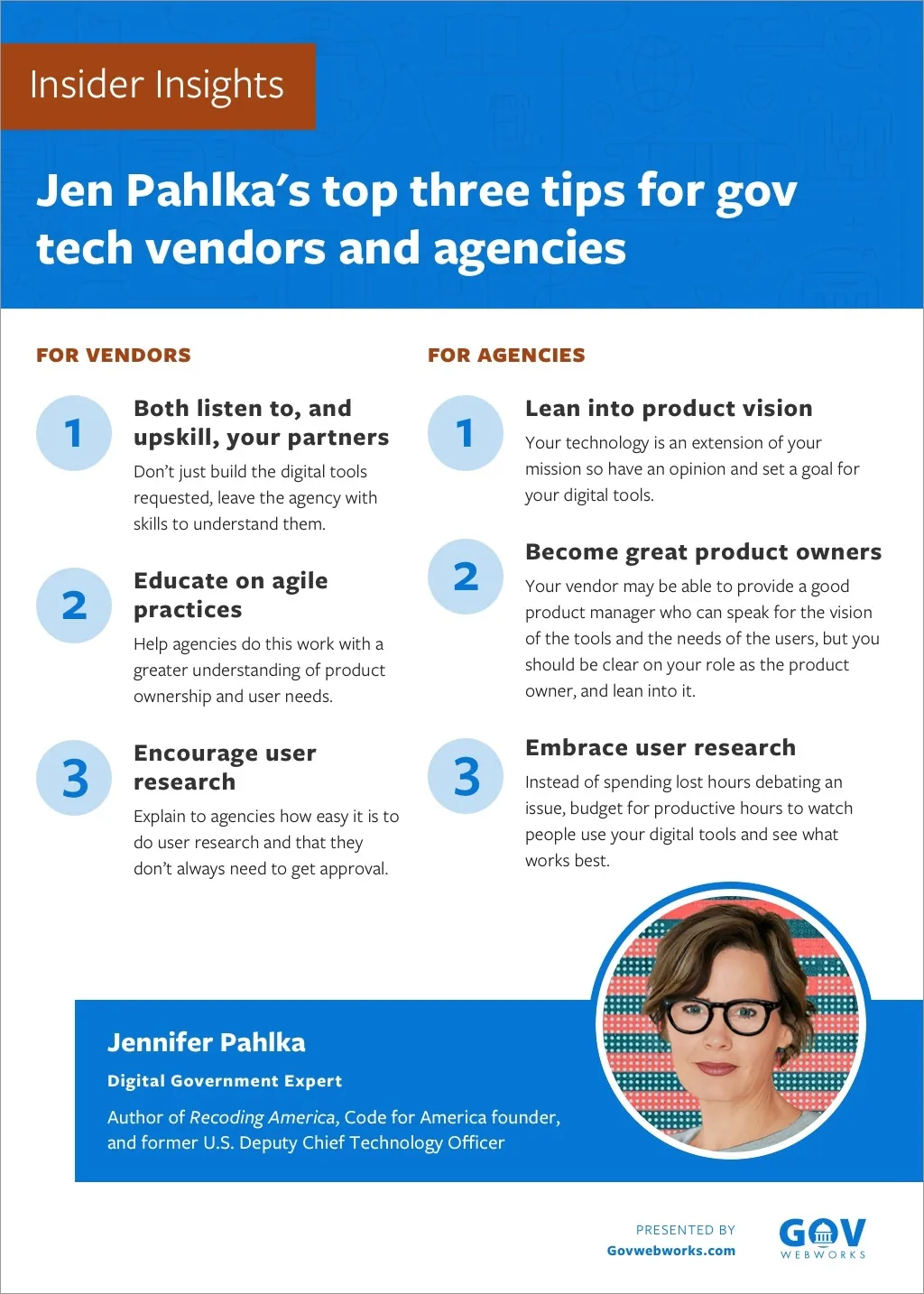
Text version (for accessibility):
Jen Pahlka’s top three tips for gov tech vendors and agencies
Jen Pahlka is the author of Recoding America, founder of Code for America, and former U.S. Deputy Chief Technology Officer.
For Vendors:
-
Both listen to, and upskill, your partners Don’t just build the digital tools requested, leave the agency with skills to understand them.
-
Educate on agile practices Help agencies do this work with a greater understanding of product management and user needs.
-
Encourage user research Explain to agencies how easy it is to do user research and that they don’t always need to get approval.
For Agencies:
-
Lean into product vision Your technology is an extension of your mission so have an opinion and set a goal for your digital tools.
-
Become great product owners Your vendor may be able to provide a good product manager who can speak for the vision of the tools and the needs of the users, but you should be clear on your role as the product owner, and lean into it.
-
Embrace user research Instead of spending lost hours debating an issue, budget for productive hours to watch people use your digital tools and see what works best.
Cyd Harrell: Adopting a user-centered mindset
- Get Cyd Harrell’s Usability Tips (opens in a new tab)
- Read the full interview: Improving Government Services
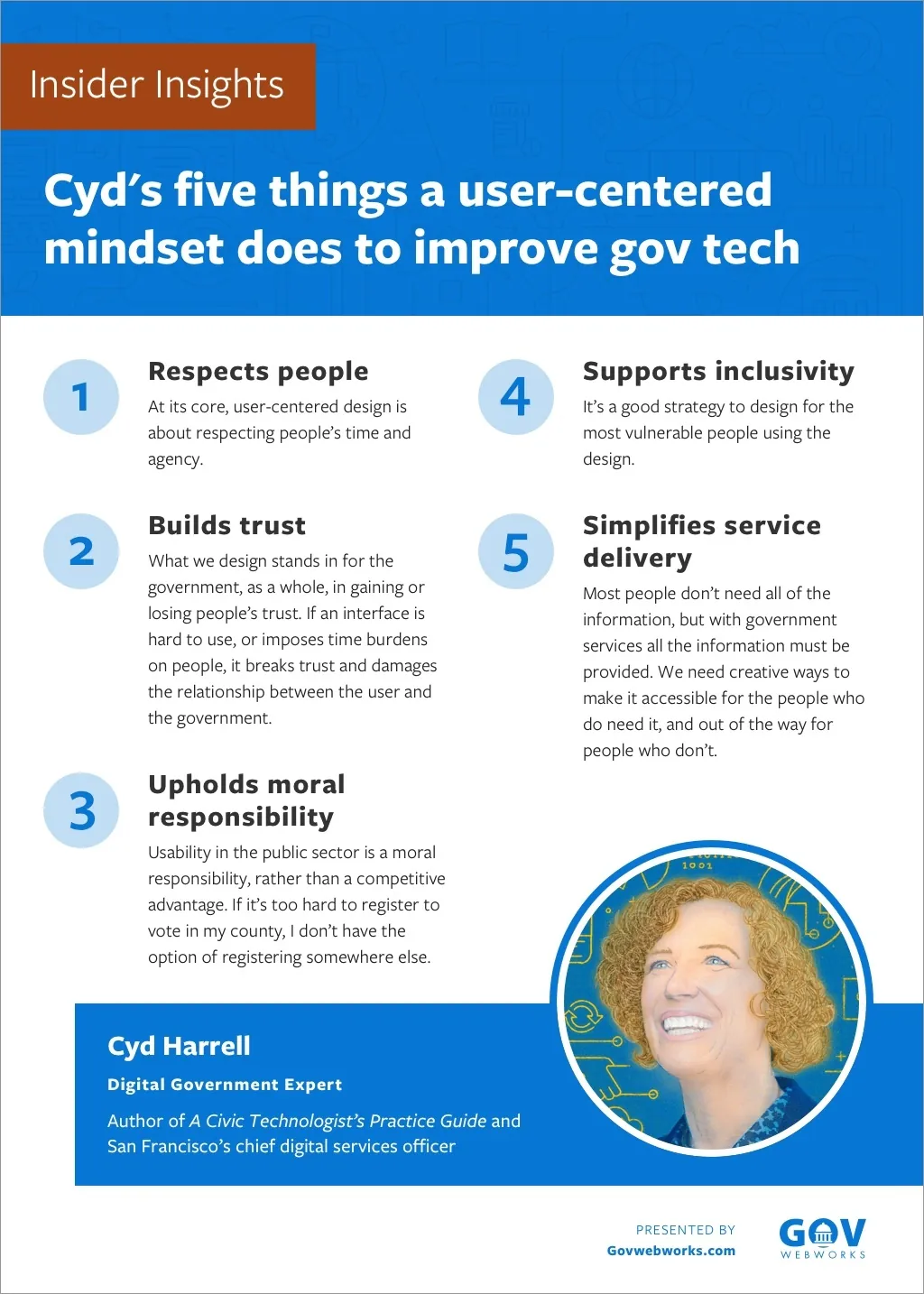
Cyd’s five things a user-centered mindset does to improve gov tech
Cyd Harrell is the author of A Civic Technologist’s Practice Guide and San Francisco’s chief digital services officer.
-
Respects people At its core, user-centered design is about respecting people’s time and agency.
-
Builds trust What we design stands in for the government, as a whole, in gaining or losing people’s trust. If an interface is hard to use, or imposes time burdens on people, it breaks trust and damages the relationship between the user and the government.
-
Upholds moral responsibility Usability in the public sector is a moral responsibility, rather than a competitive advantage. If it’s too hard to register to vote in my county, I don’t have the option of registering somewhere else.
-
Supports inclusivity It’s a good strategy to design for the most vulnerable people affected by the design.
-
Simplifies service delivery Most people don’t need all of the information, but with government services all the information must be provided. We need creative ways to make it accessible for the people who do need it, and out of the way for people who don’t.
Tara McGuinness and Hana Schank: Improving digital government services
- Get Tara McGuinness and Hana Schank’s Digital Services Tips (opens in a new tab)
- Read the full interview: Public Interest Technology to the Rescue
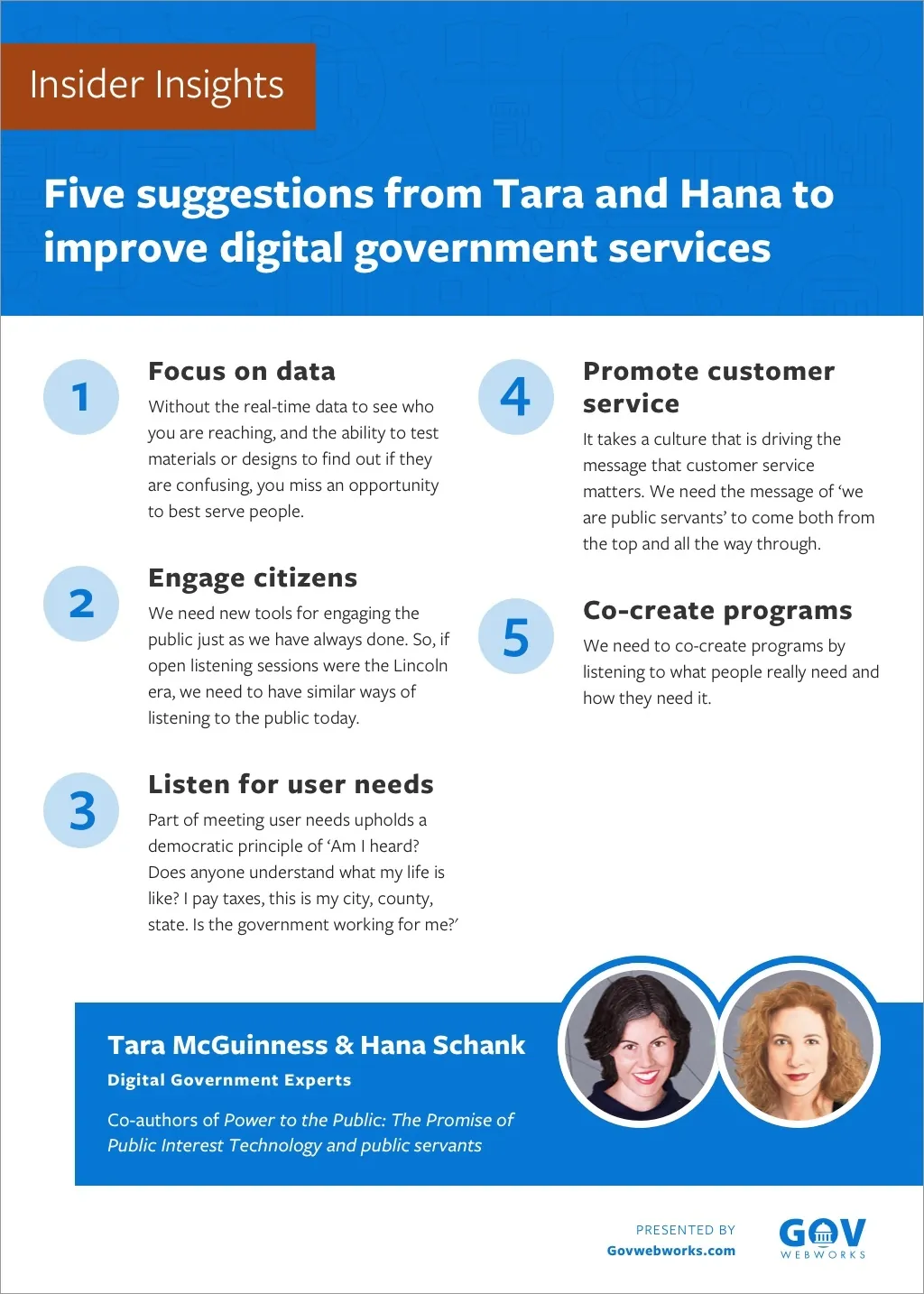
Text version (for accessibility):
Five suggestions from Tara and Hana to improve digital government services
Tara McGuinness and Hana Schank are public servants and co-authors of Power to the Public: The Promise of Public Interest Technology.
-
Focus on data Without the real-time data to see who you are reaching, and the ability to test materials or designs to find out if they are confusing, you miss an opportunity to best serve people.
-
Engage citizens We need new tools for engaging the public just as we have always done. So, if open listening sessions were the Lincoln era, we need to have similar ways of listening to the public today.
-
Listen for user needs Part of meeting user needs upholds a democratic principle of ‘Am I heard? Does anyone understand what my life is like? I pay taxes, this is my city, county, state. Is the government working for me?’
-
Promote customer service It takes a culture that is driving the message that customer service matters. We need the message of ‘we are public servants’ to come both from the top and all the way through.
-
Co-create programs We need to co-create programs by listening to what people really need and how they need it.
Continuous Improvement
Kevin Ferguson: Turning ideas into outcomes with goal setting
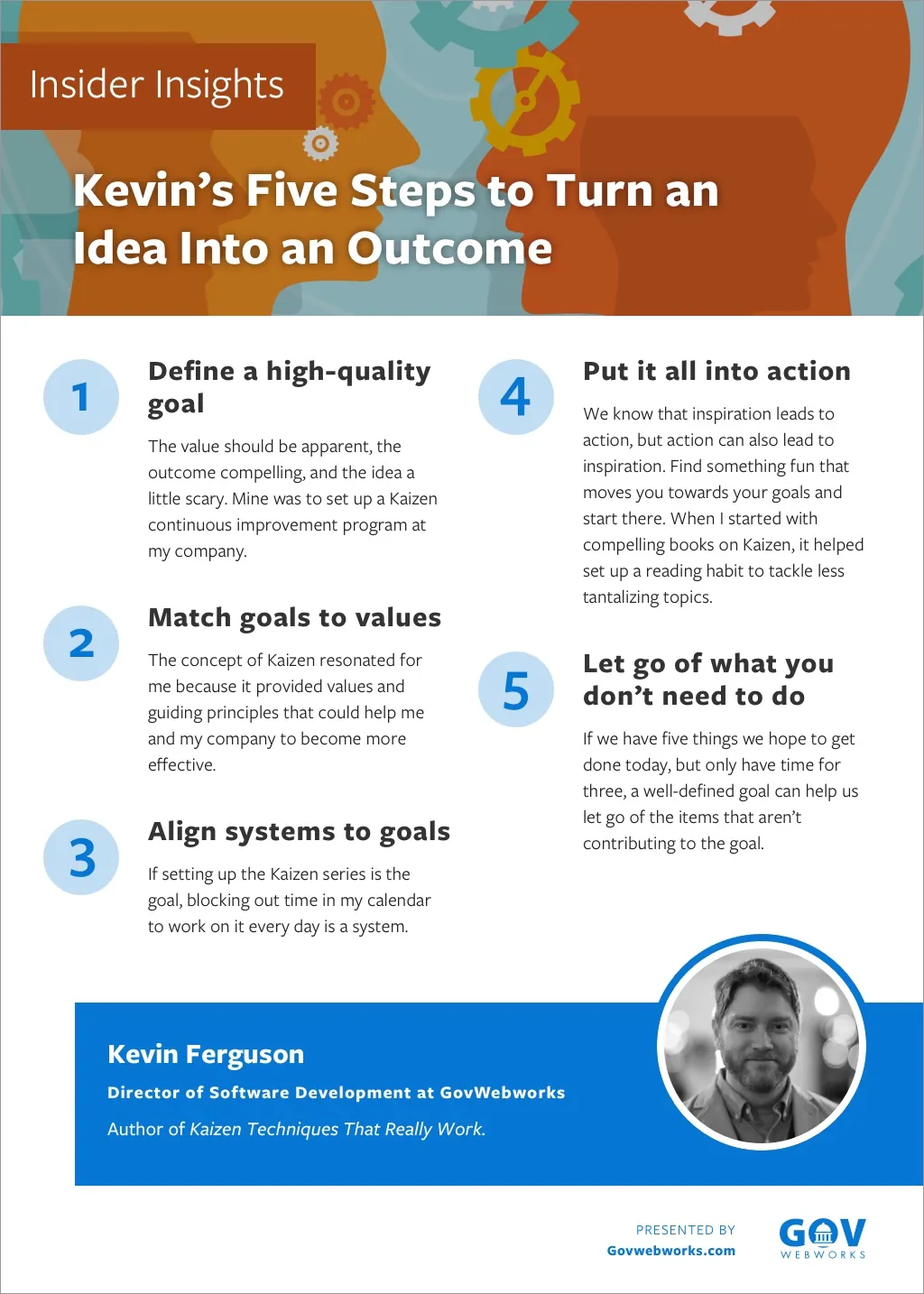
Kevin’s five steps to turn an idea into an outcome
Kevin Ferguson is the Director of Software Development at GovWebworks and author of Kaizen Techniques That Really Work, a white paper on strategies that can transform you and your organization.
-
Define a high-quality goal The value should be apparent, the outcome compelling, and the idea a little scary. Mine was to set up a Kaizen continuous improvement program at my company.
-
Match goals to values The concept of Kaizen resonated for me because it provided values and guiding principles that could help me and my company to become more effective.
-
Align systems to goals If setting up the Kaizen series is the goal, blocking out time in my calendar to work on it every day is a system.
-
Put it all into action We know that inspiration leads to action, but action can also lead to inspiration. Find something fun that moves you towards your goals and start there. When I started with compelling books on Kaizen, it helped set up a reading habit to tackle less tantalizing topics.
-
Let go of what you don’t need to do If we have five things we hope to get done today, but only have time for three, a well-defined goal can help us let go of the items that aren’t contributing to the goal.
Kristen Cox: Making government agencies more effective with Theory of Constraints
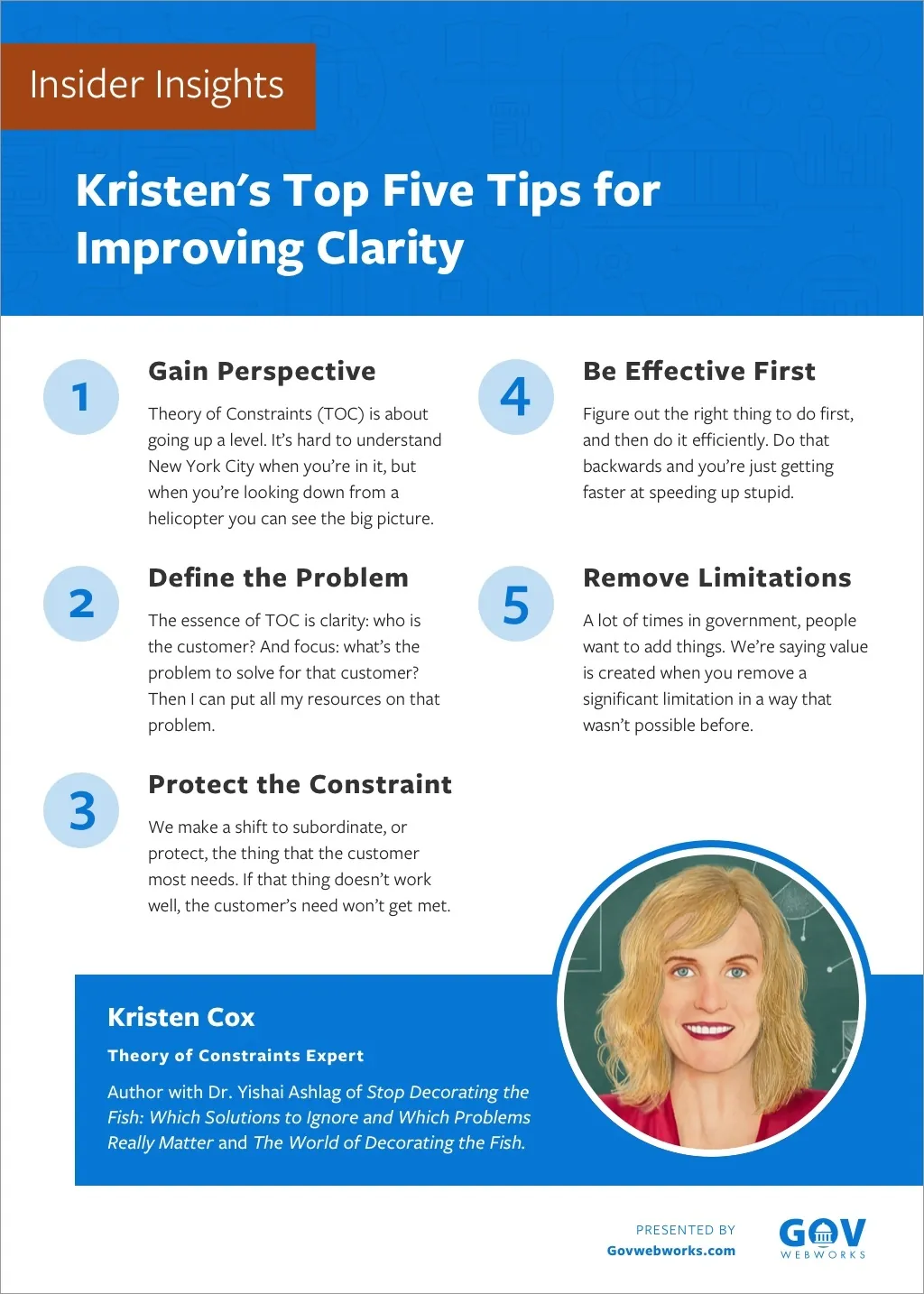
- Get Kristen Cox’s Theory of Constraints Tips (opens in a new tab)
- Read the full interview: Doing the Right Thing Well
Kristen’s Top Five Tips for Improving Clarity
Kristen Cox is a Theory of Constraints expert and author with Dr. Yishai Ashlag of Stop Decorating the Fish: Which Solutions to Ignore and Which Problems Really Matter and The World of Decorating the Fish.
-
Gain perspective Theory of Constraints (TOC) is about going up a level. It’s hard to understand New York City when you’re in it, but when you’re looking down from a helicopter you can see the big picture.
-
Define the problem The essence of TOC is clarity: who is the customer? And focus: what’s the problem to solve for that customer? Then I can put all my resources on that problem.
-
Protect the constraint We make a shift to subordinate, or protect, the thing that the customer most needs. If that thing doesn’t work well, the customer’s need won’t get met.
-
Be effective first Figure out the right thing to do first, and then do it efficiently. Do that backwards and you’re just getting faster at speeding up stupid.
-
Remove limitations A lot of times in government, people want to add things. We’re saying value is created when you remove a significant limitation in a way that wasn’t possible before.
Bob Galen: Leading by example with agile coaching
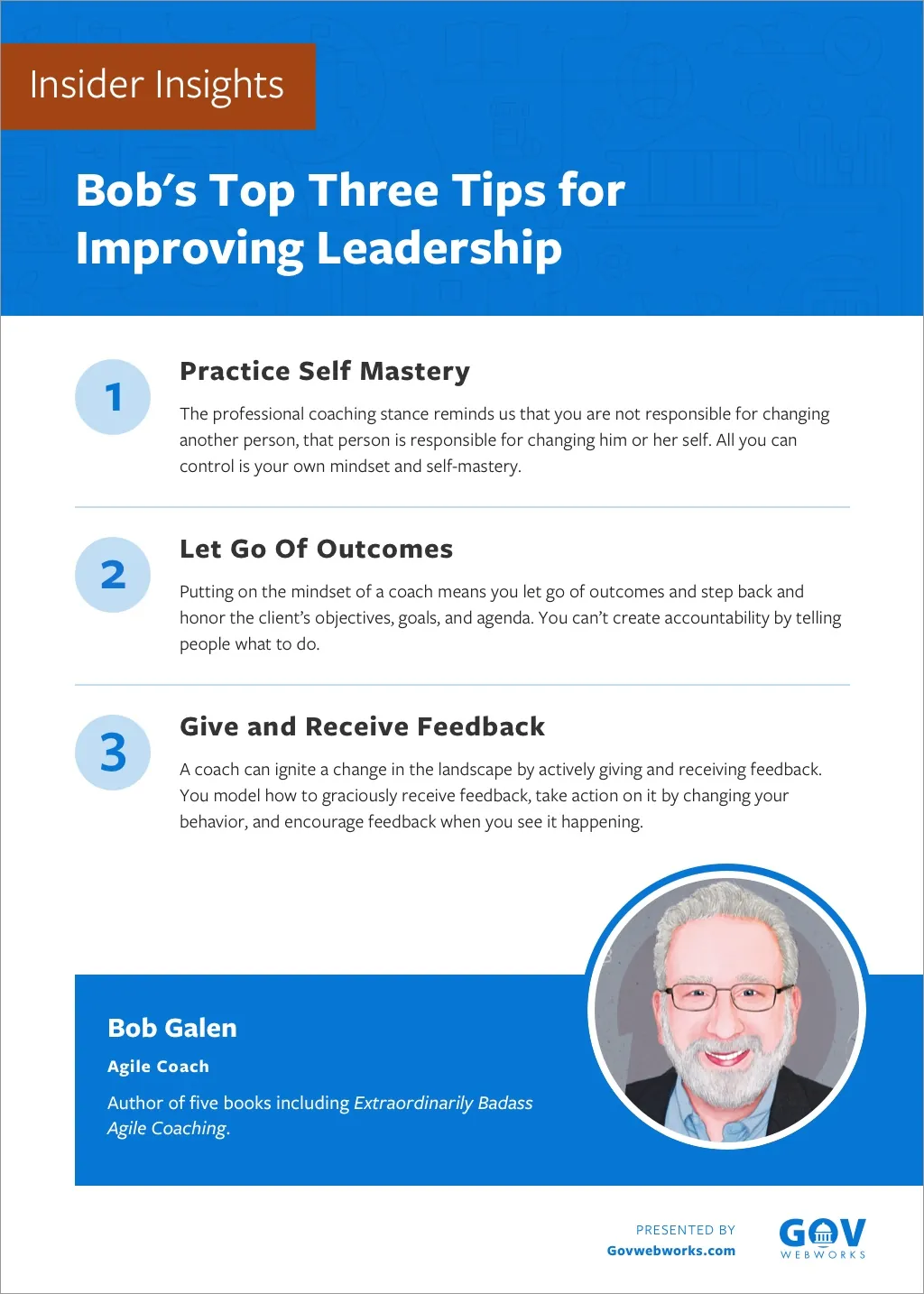
- Get Bob Galen’s Agile Coaching Tips (opens in a new tab)
- Read the full interview: The Everyday Agile Coach…
Bob’s Top Three Tips for Improving Leadership
Bob Galen is an agile coach and author of five books including Extraordinarily Badass Agile Coaching.
-
Practice self mastery The professional coaching stance reminds us that we are not responsible for changing another person, that person is responsible for changing him or her self. All we can control is our own mindset and self-mastery.
-
Let go of outcomes Putting on the mindset of a coach means you let go of outcomes and step back and honor the client’s objectives, goals, and agenda. You can’t create accountability by telling people what to do.
-
Give and receive feedback A coach can ignite a change in the landscape by actively giving and receiving feedback. You model how to graciously receive feedback, take action on it by changing your behavior, and encourage feedback when you see it happening.
Accessibility
Lainey Feingold: Building a culture of accessibility
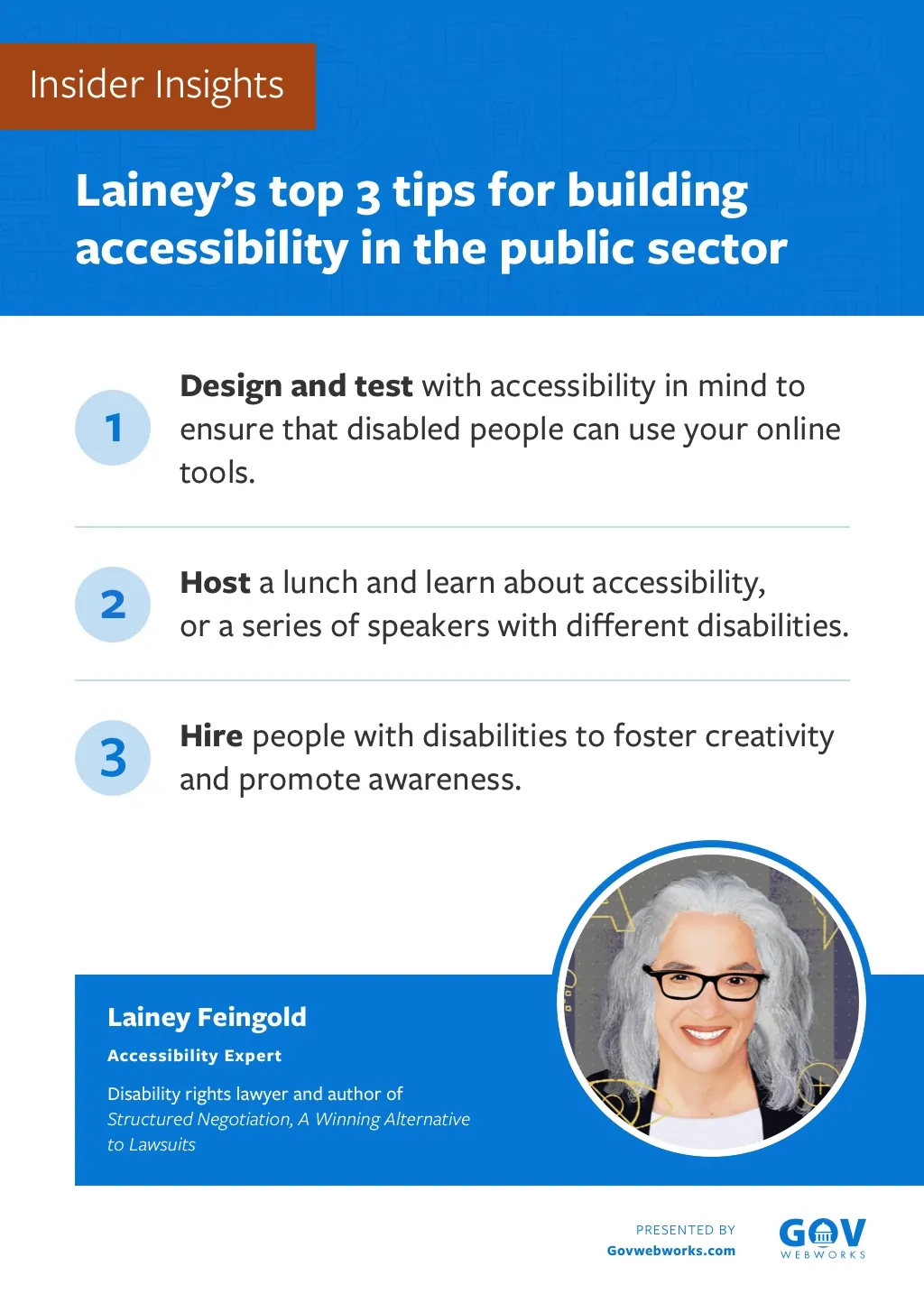
- Get Lainey Feingold’s Accessibility Tips (opens in a new tab)
- Read the full interview: Accessibility-First Mindset
Lainey’s top three tips for building a culture of accessibility in the public sector
Lainey Feingold is a disability rights lawyer and author of the book, Structured Negotiation: A Winning Alternative to Lawsuits, and has been advocating for disability rights since 1992.
-
Design and test Design and test with accessibility in mind to ensure that disabled people can use your online tools.
-
Host Host a lunch and learn about accessibility, or a series of speakers with different disabilities.
-
Hire Hire people with disabilities to foster creativity and promote awareness.
David Read: Fixing online accessibility errors
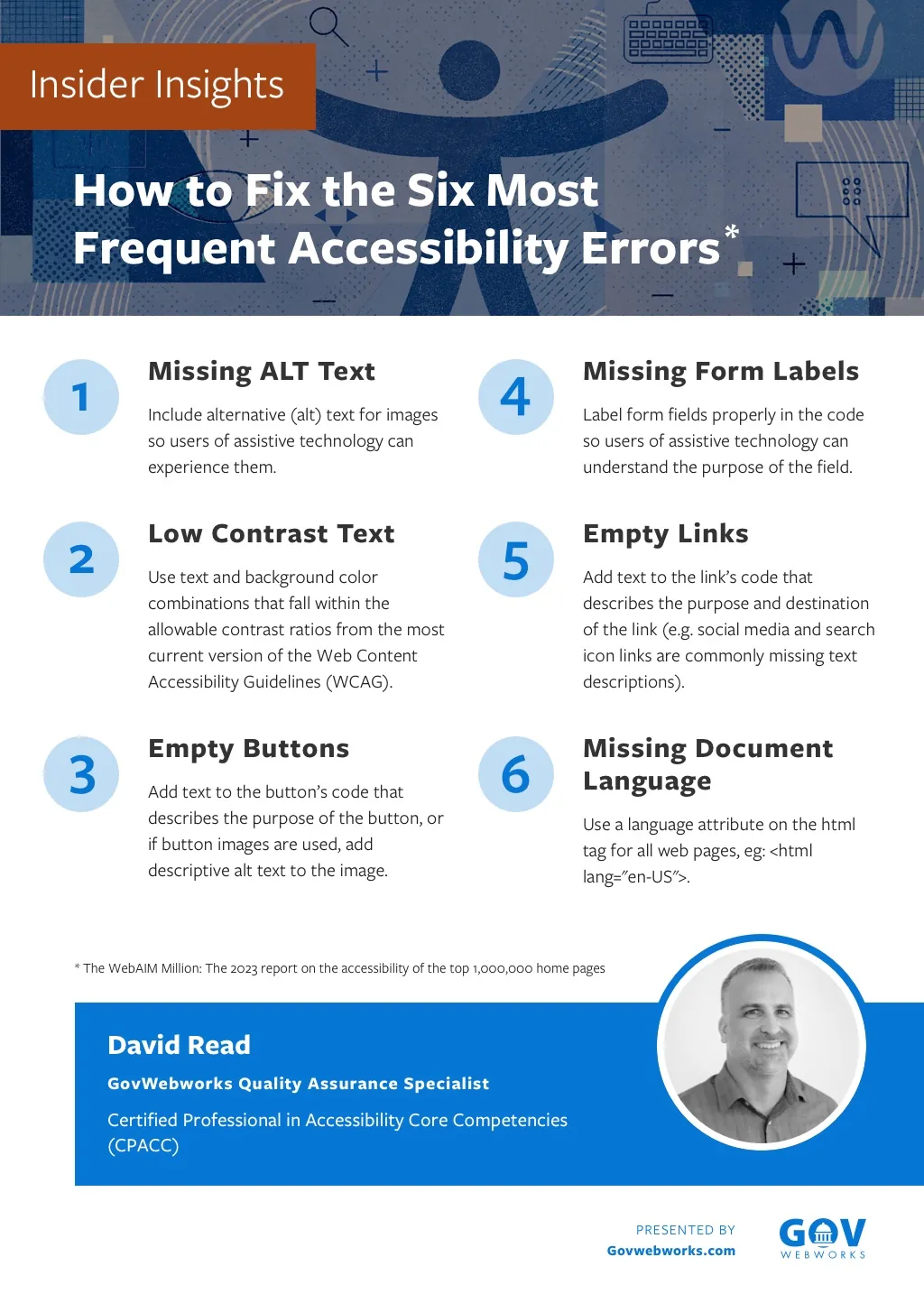
How to Fix the Six Most Frequent Web Accessibility Errors*
David Read is a Quality Assurance Specialist at GovWebworks and a Certified Professional in Accessibility Core Competencies (CPACC).
-
Missing ALT Text Include alternative (alt) text for images so users of assistive technology can experience them.
-
Low Contrast Text Use text and background color combinations that fall within the allowable contrast ratios from the most current version of the Web Content Accessibility Guidelines (WCAG).
-
Empty Buttons Add text to the button’s code that describes the purpose of the button, or if button images are used, add descriptive alt text to the image.
-
Missing Form Labels Label form fields properly in the code so users of assistive technology can understand the purpose of the field.
-
Empty Links Add text to the link’s code that describes the purpose and destination of the link (e.g. social media and search icon links are commonly missing text descriptions).
-
Missing Document Language Use a language attribute on the html tag for all web pages, eg:.
*Based on The Web AIM Million: The 2023 report on the accessibility of the top 1,000,000 home pages.
Learn more
- Public Sector Insider Insights: Perspectives from top minds on how to succeed in gov tech – Mary Uhl-Bien, Iain Kerr and Jason Frasca, Jennifer Pahlka, Kristen Cox, and Bob Galen, Jenn Page, Lainey Feingold
- Contact us for gov tech solutions
Explore other topics