
Contact Relationship Management (CRM) for Drupal can be a challenge. For those committed to the power and flexibility of Drupal, finding a truly native, modern solution for managing customer contacts has been a persistent pain point.
For instance, maybe you got burned if you had a couple of projects that were mature when Drupal 7 ended and CRM Core did not successfully transition to Drupal 8 and later. Yes, RedHen has a stable release for Drupal 8+ but it lacks the full feature set of its Drupal 7 predecessor.
CiviCRM has been a popular solution that requires third-party integrations. However, while functional, it is “shoehorned” into Drupal. As a separate product, its own data model and assumptions limits how deeply it can integrate with Drupal’s ecosystem.
We are the people who say, “There is a module for that!”, but there is no module for this. Contact management presents a core problem in many of our current projects. Not having a module for this is limiting the platform. That’s why I developed Drupal CRM. It provides a better solution to the issue of nodes. Here’s the story.
Why nodes are no good
People and organizations are often modeled as nodes in Drupal. While that is a quick fix, it is actually a bad idea. Using nodes for every person is a quick-and-dirty, one-off solution that becomes unmanageable as your project grows. The custom code you write cannot easily be shared with the community. Nodes do integrate with Drupal’s subsystems just not in the way you want. You are notifying users about content, not notifying nodes. A proper CRM needs to talk to all sorts of Drupal bits, and retrofitting this around nodes is usually way more effort than it is worth.
This lack of a mature, native solution leaves organizations feeling locked in to costly, non-native platforms like Salesforce or limited free versions from providers like Hubspot, leading to heavy fees and compatibility headaches down the line.
Introducing Drupal CRM
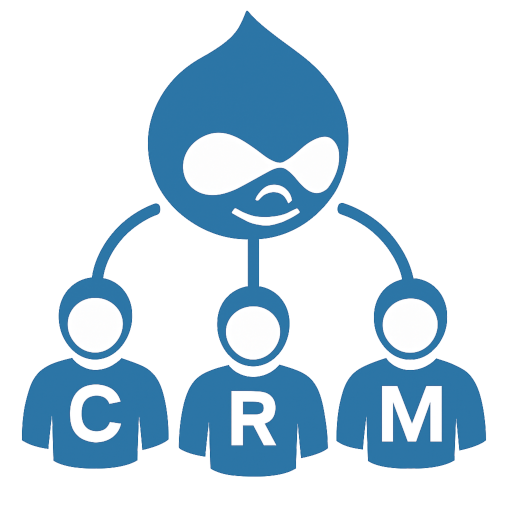 The solution to this problem is a truly native CRM. Drupal CRM is built with the goal of being a better platform than using nodes, and faster to implement than a custom node-based solution.
As I tell anyone who asks, “CRM does not do awesome stuff. It is a dependency for you to build awesome stuff.”
Drupal CRM is designed with a native entity-based architecture, a key feature that allows for robust relationship tracking and dedicated contact management. Its key features include Dedicated Contact Management, which maintains a separate registry for all contacts, distinct from the website’s user logins—essential for organizations like the YMCA that must track non-site users. It also provides Relationship Tracking to effectively track connections between various contacts, similar to modern CRM solutions. Furthermore, Fieldable Entities ensure that core data points, such as addresses and email addresses, are stored as individual, fieldable entities.
The path to CRM success
I worked at BIG COMPANY for a decade. Their CRM was old, highly customized, and just plain bad. Developers would build tools that import data from a data warehouse to do reporting, etc. I chose Drupal.
One day when migrating, I found myself drowning in custom code, and I thought, “There must be a better way to do this.” I started writing some code, and a year later I realized I had a module. People began to contact me about it, wanting to know when it would be done. Since there aren’t a lot of good options, even though it wasn’t done, it was still doing more than the others. They wanted to know when it would be stable and ready.
And now, the BETA has been released and the community has started to show up to use Drupal CRM with real projects, such as CRM Membership or CRM Case.
Stop wasting time!
The message here is simple: Don’t use nodes to represent people. Stop dedicating time, mess, and money to integrating complex, 3rd party solutions when a free, native, and scalable alternative is finally here.
“Having analyzed the options in the Drupal ecosystem, I can say with confidence that Drupal CRM provides the best foundation for representing people and the organizations they belong to in a structured way,” says JD Leonard, Project Lead, Member Platform initiative.
“The Member Platform initiative has adopted CRM as a key dependency to allow us to deliver member management software to clubs, associations, meetup groups, and non-profits globally.”
You can now install Drupal CRM and do anything you want with it. I invite you to try it out and let us know what you think.
My dream is for Drupal to have a first class CRM, just like Drupal offers first class commerce solutions. How can you help me to make this dream a reality?
- Download Drupal CRM now, give it a try, and let us know what you think!
- Come see me discuss Drupal CRM at Drupal Camp in Orlando, Florida, February 21, at Florida Technical College.
- Listen to the Module of the Week talk on Talking Drupal – Episode #537 starts at 1:11.

Learn more
- Drupal CRM details page
- Drupal CRM – Contact Relationship Management project page
- Contact GovWebworks to learn more about our Drupal services