
Washington’s Employment Security Department closed its session at the NASWA 2026 Summit with a line I’ve been repeating ever since: “The technology is the easier half” (of the project)!
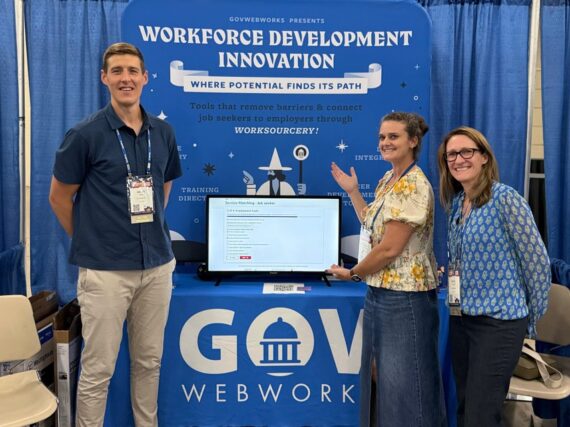
That’s a striking thing to hear from a team that just replaced two WIOA systems. But after our time in Milwaukee with more than 1,000 workforce professionals at the National Association of State Workforce Agencies (NASWA) Summit, think they’re right when it comes to rebuilding workforce systems. The GovWebworks team sat in on sessions from a range of states, including Minnesota, New York, Washington, Colorado, and a cross-sector panel on the future of labor exchange.
The states making real progress weren’t the ones with the most innovative technology, they were the ones who got three things right before and during the build. These states prioritized the following three steps:
- Map what they already have in place.
- Do the data work early in the process.
- Put partners at the table from day one.
What struck me was how consistently the states that skipped one of these paid for it, and how much easier everything else got for the states that followed these simple steps.
The other thing that struck me at NASWA 2026 was how the AI conversation had changed. A year ago at this same Summit, AI was everywhere in theory: panels about potential, policy, and guardrails. This year, we saw discrete, practical applications, such as a chat tool that helps someone find an apprenticeship, or an interview practice agent that gives case managers hours back. Each tool was designed to either enhance the experience or lighten the load. AI is also starting to play a supporting role in the three practices mentioned above, but humans are still clearly in the loop.
Here are our takeaways from NASWA 2026:
1. Map what you already have
The talent marketplace panel opened with a reminder that’s easy to forget in a modernization conversation. The panel moderated by NASWA’s Amber Gaither with Jason Tyszko of the U.S. Chamber of Commerce Foundation, Anna Hunter of Arizona’s Department of Economic Security, and Emilie Rafal of 1EdTech, reminded us that the public workforce system already solves an essential problem. State job banks, American Job Centers, and NLx connections actually work. That’s why the next generation “should build from the public workforce foundation, not erase it,” as one panelist said.
The harder question, as one of the slides put it, is “how do systems connect without new silos?” Their advice was to map existing assets before writing a technology shopping list, and to decide what can be connected or reused.
Minnesota showed what that looks like in practice. Ryan Wold, DEED’s Workforce Development Product Owner, and Paula Bergerson, Technical Program Manager, described replacing MinnesotaWorks.net, a labor exchange that had served the state since 2007, with CareerForce.MN.gov. In the interest of full disclosure, GovWebworks is DEED’s partner on the CareerForce front end, so I’ll admit some pride here. But what I want to highlight is the architecture, which DEED described as three layers:
- A public front door for job search, event registration, and wage and industry information.
- A middle layer of shared services, including NLx, CareerOneStop, and CiviServ(our platform).
- A state-managed data foundation, hosted in Microsoft Azure and run by MNIT.
Each layer has a clear owner. The front door connects to services the state already had, instead of rebuilding them. And because DEED mapped those connections first, the new site is becoming a place to consolidate services and tools rather than being just one more thing to maintain. Most recently they’ve secured funding to retire a separate career and education site and move the Eligible Training Provider List into CareerForce.
The results in the first three months, compared with the same period a year earlier, saw active users were up 57% (165,307 to 259,021), and job search views were up an amazing 111% (450,953 to 950,435).
Allison Johnson of NASWA, describing a very different project, landed on the same principle. “We don’t want to create another job board. We don’t want to create another labor exchange.” I had to agree. The goal is not to rebuild, but build on what is already working.
Where we saw AI help: The mapping is tedious work, and this is a place where AI tools earn their keep. They’re good at digesting years of system documentation, comparing data fields across platforms, and drafting a first inventory that your teams then verify. That doesn’t replace the judgment about what to keep and what to connect, but it can shorten the path to it.
2. Do the data work early
Allison Johnson’s session at NASWA 2026 was ostensibly about AI, but the story she told was not just about data, it was also about a man her project team came to call “Turtle Guy”. She and a team from the New York State Department of Labor built a chat-based Registered Apprenticeship Finder in about four months, and it’s now in public beta.
During user research, they interviewed a young man whose resume listed one job. Asked about his skills, he said, “I don’t know. I’m just a dishwasher.” The interview ran long, so they kept asking. He talked about his pet turtles and how when their tank broke and he couldn’t afford new parts, he took it apart and fixed it. Now he buys old tanks at flea markets, repairs them, and passes them on to friends.
“If you looked just at his resume, you’d see that he just had one job,” Allison said. What the team heard instead was “someone who has a mechanic’s mind.” Traditional career tools never would have seen it, because the only data they had about him was a job title. The takeaway here was that the new system needed to do more than just ingest surface data, and also needed to be able to probe deeper, to uncover someone’s full capabilities.
The other side of the data problem was just as stubborn. New York’s apprenticeship program information was little more than a long list on a website. Before any matching could happen, the team had to turn that into structured data and connect it to O*NET occupation attributes. “This has to underlie all of the work that AI is going to be doing,” she said. The matching came later, and relatively quickly.
Where we saw AI help: New York’s experience is a good example. Large language models are well suited to taking unstructured program descriptions and extracting the attributes a matching engine needs. The team also used AI tooling to evaluate and compare models before committing to one. What AI can’t do is decide what the data should mean, or natively know how to ask the right questions. The subject matter experts are still important in making those connections, and training the models.
3. Put partners at the table from day one
Washington Employment Security Department’s was the most candid session I attended, and the agency deserves real credit for it. Its two WIOA systems went live in May 2016 and, in the team’s own words, were both broken. A second attempt in 2018 also failed. A 2020 State Auditor finding confirmed what staff already knew: the data model underneath the state’s federal reporting was flawed. Nobody on the vendor side understood PIRL, the roughly 525 data elements that feed every WIOA performance conversation with DOL. When they interviewed 22 people about what went wrong, the causes had little to do with code. Instead it was due to a vague contract, staff stretched across competing priorities, an agency trying to direct a software build without the expertise to do it, and local workforce boards left out of the design entirely.
Their conclusion was blunt. “This wasn’t just a technology problem. It was a governance problem in a technology wrapper.”
So on the third attempt, they rebuilt the structure before the software. All 12 local workforce development boards became co-builders, reviewing working software in three-week sprints instead of waiting for acceptance testing at the end. Now, a product manager owns the roadmap, business owners make business decisions, and the technology team serves the product. Washington describes this as a three-legged stool, then adds a fourth leg it calls critical: executive sponsors who hear hard news first and provide air cover “when it gets uncomfortable, and it will get uncomfortable.” A new, more successful system went live on June 9, 2026.
Like Washington, Minnesota DEED said in their presentation that “business and technical partnership is non-negotiable.” With shared ownership of outcomes from planning through launch, their acknowledgments slide was titled, “It took a village.” The village included a steering committee, a digital products team, a content coordination group, data and reporting teams, and a half-dozen MNIT groups covering middleware, identity, security, and procurement, plus legal and communications. Each of those groups had a reason to say no at some point. Having the right people in the room early is how a complicated registration page gets built once instead of three times.
Where we saw AI help: By giving people time back for the partnership work itself. Colorado’s Department of Labor and Employment is piloting an AI interview practice agent, and the way Kelly Folks and Stephanie Mufic framed it to their own workforce is instructive. Every hour a case manager spends on rote interview drills, one slide read, “is an hour not spent on the complex, barrier-removal work that requires a human.” Their playbook presents AI as “a capacity-builder, not a replacement,” and pairs every pilot with staff training on how to interpret what the tool produces. Colorado’s approach is a good model: use AI to absorb the rote tasks, be explicit with staff about why, and define how you’ll measure success before anything scales. The trust that makes a partnership work is still built by people.
The work before the work
The common theme in the lessons from NASWA 2026 is that they all take place before and underneath the product. Mapping systems, structuring data, and convening partners are also what separated the success stories in Milwaukee from the cautionary tales. Washington’s closing slide said it best: “Washington didn’t just buy new software. We rebuilt how we govern and deliver technology products.”
For our team at GovWebworks, this all matches what we’ve seen on our own workforce projects. The front door matters, because it’s where job seekers, students, and employers decide whether a system is worth their time. But a front door only works when it connects to a foundation that’s been mapped, data that’s been made trustworthy, and partners who helped shape it. Turtle Guy deserves a system that can see what he’s capable of. Getting there is less about the algorithm than about the work that comes before it.
Thank you to NASWA and to every state team that shared its work, including the parts that didn’t go well. We’ll see you in Atlanta for the 2027 Summit, September 15–16.
Learn more
- Elevating the Workforce System: 2026 SUMMIT in Milwaukee
- Doing More With Less For Workforce Development: Workforce development trends to watch in 2026, by Brett Kana
- Contact us for a free demo of our workforce development tools
Sources: NASWA 2026 Summit recap; session presentations from NASWA, Minnesota DEED, Washington’s Employment Security Department, and the Colorado Department of Labor and Employment.