
Launch day is one of the most exciting moments in a website project. Months of planning, analysis, design development, and testing culminate in a polished digital experience that everyone is proud to share.
Fast forward three years, and a client tells us that staff are spending hours of their days on the phone connecting users to content that should be just a click away. “The original goal was to unify multiple state agency websites under a single umbrella,” recalls GWW content specialist Sarah Pizzolato, “but users were unable to find critical information on the site.”
What happened? Two or three years is enough time for an organization to experience significant changes. New legislation is passed, programs evolve, staff members come and go, priorities shift and compete. None of this is unusual, it’s completely normal and healthy for organizations to evolve and adapt with the times. However, the challenge we’ve seen agencies struggle with is keeping websites up to date and in sync with the realities outside the digital walls.
So what’s the secret to ensuring that your web presence ages gracefully? We call it content stewardship.
Monuments versus gardens
Over the years, we’ve observed that organizations often treat websites like monuments. A monument is built once, admired, photographed, and largely left alone. Aside from the occasional cleaning, it doesn’t require much attention or maintenance.
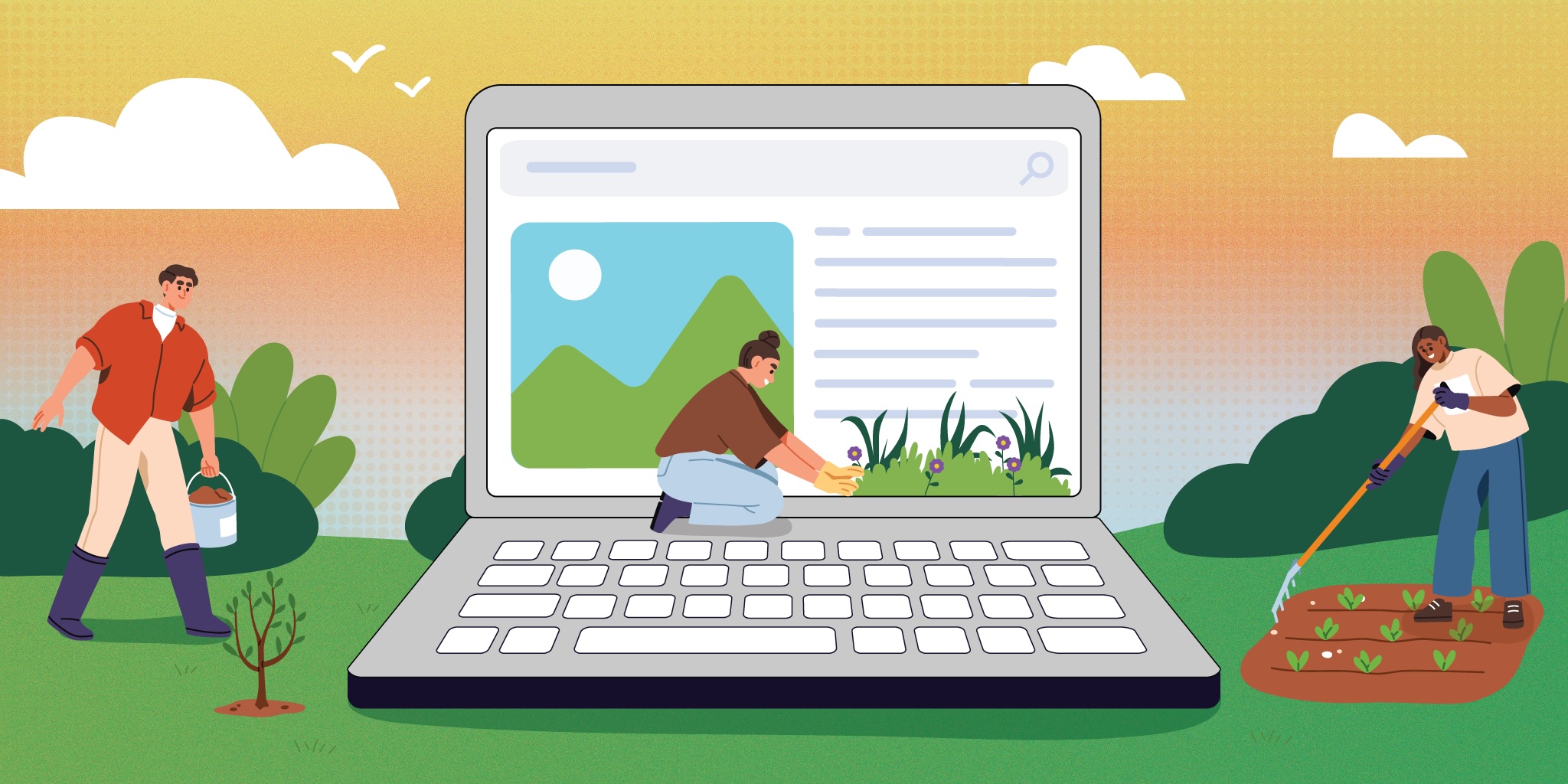
We’ve found websites are more like gardens. Gardens are living systems. They grow, change, and evolve over time. They require regular care and attention. Left unattended, even the most beautiful garden can become overgrown. Weeds begin to appear, paths become overrun, plants compete for sunlight. What was once thoughtfully designed and laid out becomes a tangled, impassible mess. As designers and builders of websites, we’ve seen our fair share of digital gardens become overgrown.
Pruning the digital garden
Most websites don’t fail dramatically. They simply become a little less useful, a little less consistent, and a little less effective over time. Instead of weeds and overgrown pathways, we start to see inconsistent page layouts, dated imagery, accessibility issues, obsolete or duplicate information, confusing navigation, cluttered content, and general fragmentation. This isn’t anyone’s individual ‘fault,’ and it isn’t a software problem. It’s the result of entropy, the tendency for systems to gradually drift toward disorder if left unattended.
In the case of the client mentioned earlier whose staff were spending hours a day helping users find information on the site, their website entropy was becoming acutely painful. Fearing the worst, they were beginning to wonder whether they needed another website overhaul. They were relieved at our assessment that there was nothing inherently ‘wrong’ with their website – and that they certainly didn’t need a new one!
What they needed was to de-clutter their garden, and we were there to help with the following best practices. As content gardeners, we:
- Worked closely with the agency’s subject matter experts to conduct an inventory of the site’s content and organization.
- Identified editorial inconsistencies, divergent component usage patterns, and content overlaps.
- Trained the agency’s content management team and coached them up to a point where they felt empowered and equipped to “prune back the sprawling growth of stub pages and inaccessible PDFs that had accumulated over time.”
The result was a coherent site structure that improved the current user experience while also laying the groundwork to grow and evolve with future content.
Sites that age well, work well
Fortunately, not every website plunges into such a state of disarray where it needs so much fixing. We’ve seen plenty of websites that continue to thrive years after launch when clients know how to keep them well tended.
What’s interesting is that the sites that age well aren’t necessarily designed better, engineered differently, or supported by larger budgets. The organizations that do the best job maintaining their sites treat them the way a gardener treats their garden–with regular attention and a commitment to continuous improvement. They have clear standards, regular review cycles, attention to user feedback, and opportunities for their staff to develop their skills. They don’t wait for problems to become overwhelming before addressing them.
Observing this pattern over the years led us to ask a simple question:
How do we help clients avoid the gradual drift that so many websites experience after launch?
Breaking the cycle
The answer to this question led us to develop the GovWebworks Content Stewardship Program. The goal isn’t to sell large-scale redesigns or major corrective efforts. Rather, it’s to help organizations preserve and strengthen what they already have through routine preventative maintenance. This program is an ongoing partnership combining expert guidance and hands-on support centered around five core pillars:
- Accessibility: Periodic accessibility testing and remediation to make sure the site never falls out of compliance.
- Content Development: Content planning & development support to keep the communications strategy on track.
- Content Quality Governance: Regular audits of newly added content for consistent adherence to readability, tone of voice, and visual guidelines.
- User Feedback Insights: Feedback mechanisms and analysis to keep a pulse on the site’s evolving audience needs.
- Analytics & Performance: Continuous monitoring and analysis of user analytics data to help understand how the site is performing and where it might improve.
Most importantly, this program is designed to empower content managers. It comes with the option for tailored training refreshers and coaching as needed to keep your content team sharp. You’re steering the ship, you’ve just got an extra set of hands on the wheel for added guidance.
Protecting your investment
Launching a website is an important milestone, but it isn’t the finish line. Just like gardens, the websites that provide the most value over time are rarely the ones that are simply left alone. You know a well-tended website when you see one:
- Well organized and easy to navigate
- Accessible, accurate, and up-to-date
- Consistent language, clean visual styles, and clutter free
With attentive care and proactive management, your website can serve your organization and your citizens for many years to come. Like any long term asset, small, regular investments in maintenance tend to be more effective and less expensive than large-scale corrective efforts once problems have accumulated.
As anyone on our team will tell you, the best websites aren’t simply launched, they’re cultivated. Building and launching a website creates value, but stewardship preserves value.
Learn more
- Interested to learn more about the GovWebworks Content Stewardship Program?
Contact us, we’d love to chat. - Govern Your Content, Don’t Let It Govern You: Best practices and tools for governing content in Drupal
- 9 Best Practices for Web Content Accessibility: How to grow accessible digital experiences, by Sarah Crossman